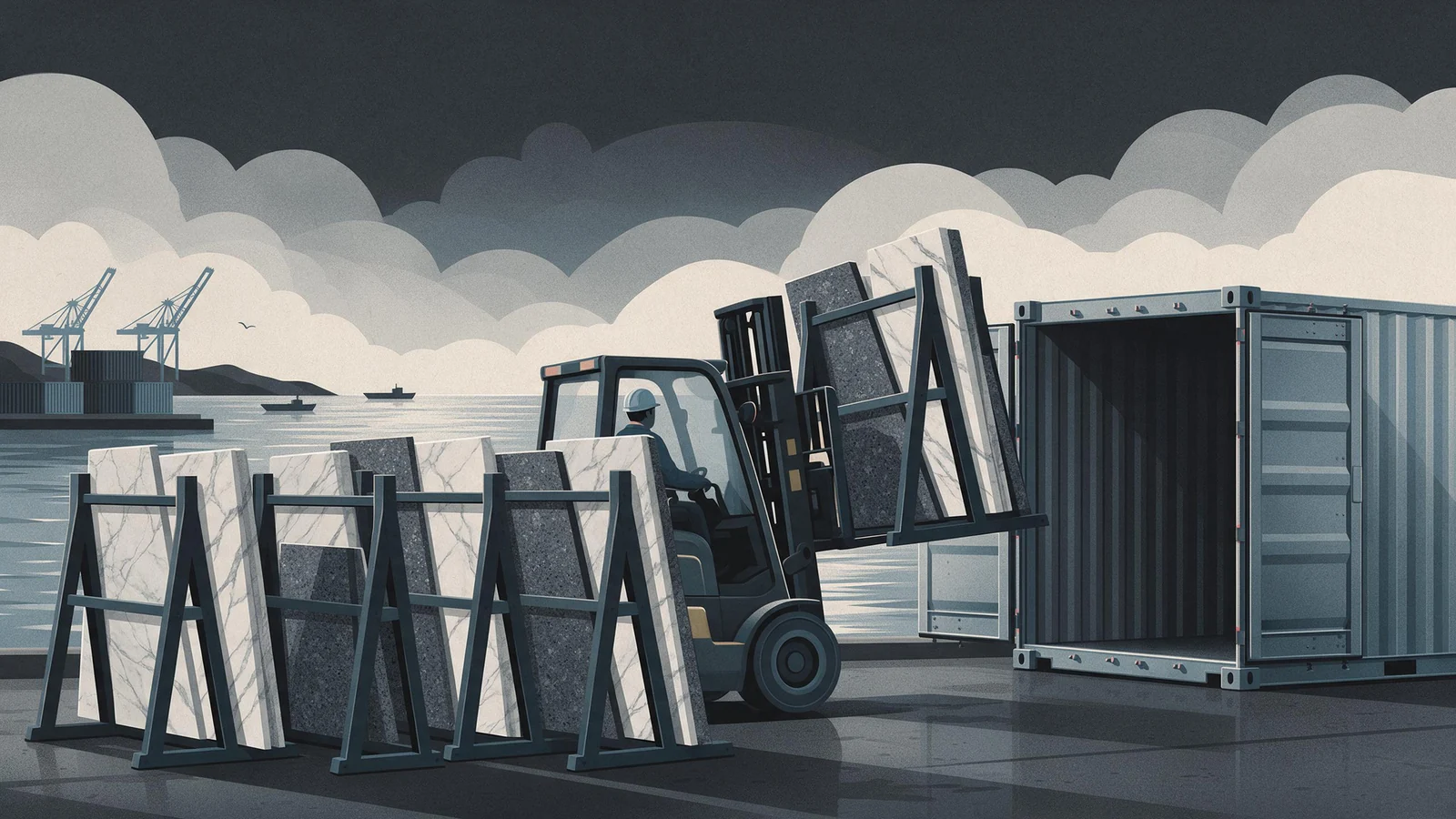
Importing stone slabs from China is less about finding a supplier and more about controlling a sequence: choose the right stone, confirm the sample, agree the trade term, and get the container loaded without surprises. This guide walks through each step for marble, granite, quartz and sintered stone, with the practical details buyers ask about most.
Start with the stone type and the application
Stone is not one product. The varieties Winway supplies include marble, granite, quartz, sintered stone, travertine, limestone, sandstone, onyx, slate, basalt, alabaster and Calacatta marble. Each suits different parts of a project, and the application usually decides the choice before price does.
For a villa or hotel lobby, marble and Calacatta marble are common choices for feature walls and floors. Granite, quartz and sintered stone are among the stone types Winway supplies for kitchen, bathroom, wall and floor applications. Onyx and alabaster tend to appear in smaller decorative areas. Slate, sandstone, limestone and basalt are often specified for outdoor, rooftop and wall applications.
If you are still comparing categories, the stone slabs page groups the main options, and marble covers the marble range in more detail. Quartz and sintered stone are listed separately for buyers who want a man-made surface alongside natural stone.
Match the stone to the room, not the catalogue
A kitchen counter, a bathroom wall and a hotel corridor all put stone in different contexts. Winway supplies stone for villa, hotel, apartment, office, restaurant, kitchen, bathroom, wall, floor, rooftop and outdoor applications. Tell the supplier which room each slab is for, and the shortlist narrows quickly.
Ask for samples before you commit
Samples are free of charge across all product categories. You pay the international shipping cost only. This is the cheapest part of the whole import process and the one that prevents most disputes later.
When the sample arrives, look at it in the light of the room it will sit in, not under a warehouse lamp. Compare the sample against your reference image. If the project needs several slabs from the same block or batch, ask how consistency is handled before production starts.
Winway guarantees that the materials used in production are consistent with the approved samples. For custom orders, a pre-production sample approval step comes before full manufacturing begins.
Understand FOB, CIF and EXW before you negotiate
Winway supports FOB (Foshan or Guangzhou port), CIF, and EXW. FOB is the most common choice for international buyers who work with their own freight forwarder. CIF is available for buyers who prefer Winway to arrange ocean freight and cargo insurance to the destination port.
As general industry knowledge, Incoterms 2020 defines where risk transfers from seller to buyer. Under EXW, the buyer handles export formalities and the entire transport. Under CIF, risk transfers once goods are loaded on board at the port of shipment, and the seller arranges minimum insurance cover. These definitions are published by the ICC and are not specific to any supplier.
| Term | Who arranges freight | Typical use |
|---|---|---|
| EXW | Buyer | Buyer has a forwarder in China |
| FOB Foshan / Guangzhou | Buyer | Most common for importers |
| CIF | Winway | Buyer wants freight and insurance arranged |
Door to door is available for some countries. It is not the same as DDP, and Winway does not offer DDP or DAP.
Plan the container and the shipping time
Sea freight, whether FCL or LCL, typically takes 15 to 45 days depending on your destination port. Southeast Asia is faster; Europe, Africa and the Americas take longer. Air freight for samples or urgent small orders arrives in 5 to 10 business days.
For African buyers, coordinated shipment reaches major ports including Durban, Mombasa, Lagos and Tema with proper documentation. If you have no experience in international import and export, Winway can help you solve delivery and shipping problems.
As general industry knowledge, a 40 foot High Cube container offers roughly 12,032 mm internal length, about 2,700 mm internal height and a capacity of about 76.3 to 76.4 m3. Maximum payload is around 28,200 to 28,670 kg, though actual limits depend on the shipping line and road weight rules at destination. Stone is heavy, so confirm the weight allowance with your forwarder before you plan the load.
Building materials from different categories can be consolidated into one container. Winway helps customers fill containers by model and quantity without wasting container space, and the logistics team counts the goods again during loading and takes photos and videos.
Documents, duties and destination rules
Winway prepares all standard export documents: commercial invoice, packing list, bill of lading, and certificate of origin (CO). Additional documents such as fumigation certificates, MSDS sheets, or product-specific test reports can also be arranged as required by your country's customs authority.
Some African markets run pre-export verification programmes. As general industry knowledge, Kenya's Pre-Export Verification of Conformity (PVoC) programme, run by the Kenya Bureau of Standards, assesses goods in the exporting country, and a Certificate of Conformity is required for imports. Tanzania runs a PVoC programme through the Tanzania Bureau of Standards; whether a given product falls under the regulated list should be confirmed with your clearing agent. These are general market requirements, not statements about any particular supplier.
Third-party inspection reports and factory audit documentation are available on request for any product line. Every order goes through documented quality control before shipping, and buyers receive detailed quality inspection reports and container loading photographs.
Work with a supplier who handles the whole order
Winway was established in 1997 in Foshan, China, and has over two decades of experience in design and building materials supply. The company is a one-stop professional building materials solutions provider, delivering comprehensive services from design to installation.
Winway keeps a 5,000 m2 showroom in Foshan. The company has a ceramic tile factory, a sanitary ware factory and a door and window factory, together with a complete design team and after-sales service team. A sales team of more than 200 people handles enquiries, and products have been delivered to more than 100 countries, serving over 100,000 customers worldwide.
Winway does not own a stone factory. Stone is sourced and coordinated alongside other building materials, which is useful when a project needs stone plus tiles, sanitaryware or doors from one team. Orders of any size are accepted, from single samples to full containers, with a strong focus on the African market.
The process is straightforward: send your detailed enquiry and sketches with dimensions, layout, colours, materials and finishes. Winway replies with a detailed quotation within 24 hours, then prepares 2 to 3 design options for your approval, free of charge. Once approved, a contract is signed and production begins. Installation support is available, with on-site advice from architects or a construction team.
Winway has supplied projects across Africa, including villas, apartments, hotels, a hospital, a spa and a bar in Zambia, Tanzania, Uganda, Senegal, the Republic of the Congo, Burkina Faso, Kenya and Ethiopia. For buyers comparing suppliers, the about page covers the company background, and the blog has more sourcing notes.
Common mistakes to avoid
Buying on price alone is the first one. Stone varies by batch, and a quote that does not name the variety, finish or application is hard to compare. Ask for the sample first, then the quote.
Second, leaving the trade term vague. FOB, CIF and EXW put different costs and risks on each side. Decide early who books the freight.
Third, forgetting the destination rules. PVoC and similar programmes can hold up a shipment if documents are missing. Check with your clearing agent before the container leaves Foshan.
Finally, treating stone as a last minute purchase. Samples, approval and production all take time, and sea freight adds 15 to 45 days. Start the process early enough that the stone arrives when the site needs it.