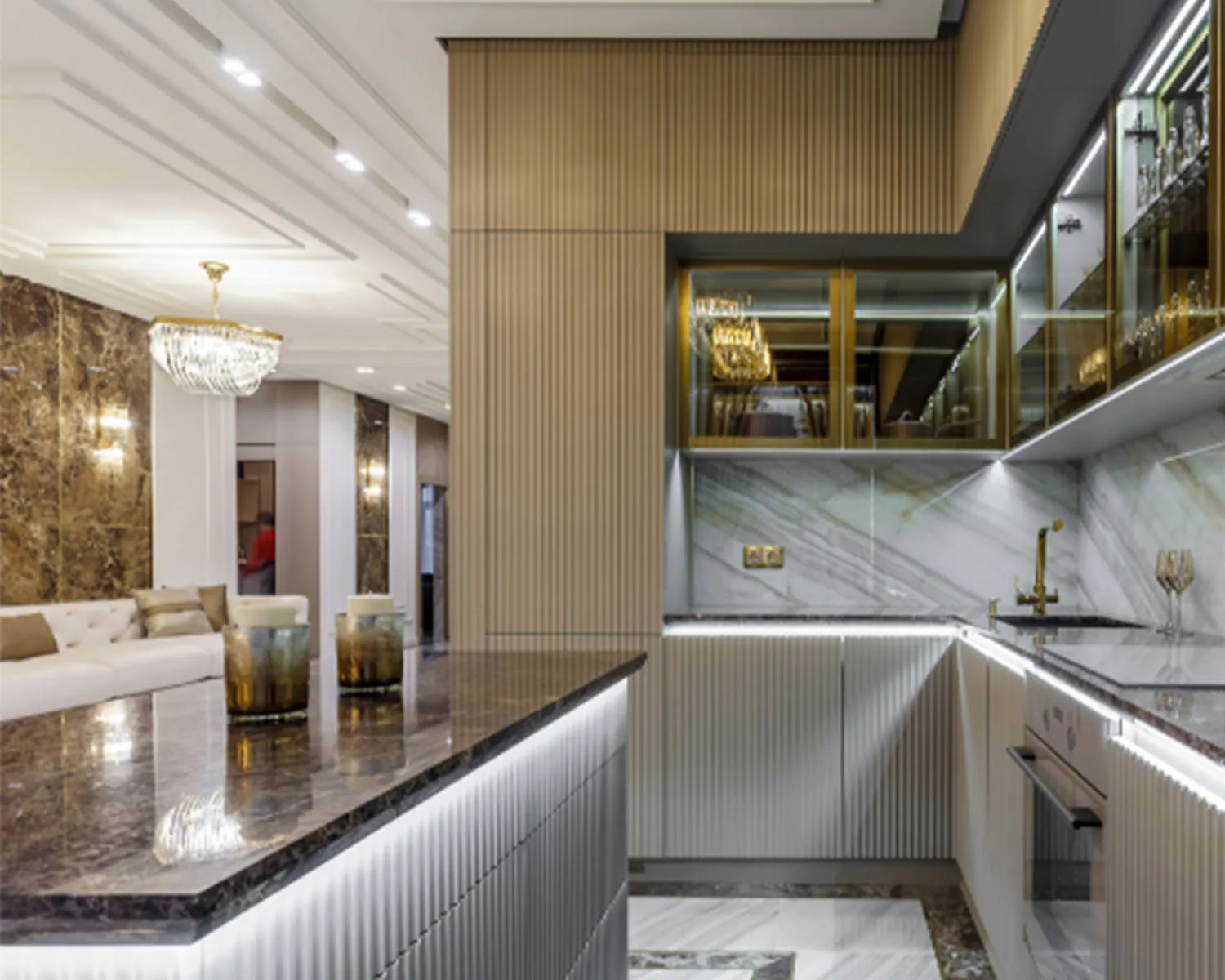
How Marble Countertop Pricing Is Structured
A marble countertop quote rarely shows up as one flat number. You get a breakdown instead: slab material, fabrication work, installation labor, and a set of project-specific fees. Seeing how those pieces fit together makes comparing offers from different suppliers less of a guessing game.
Fabrication covers cutting the slab to your template, shaping edges, and polishing exposed surfaces. Installation labor includes templating on site, delivery, and fitting the pieces into place. Suppliers usually quote these services separately from the stone itself, so what you pay depends on local labor rates plus how complex the job is. A straight run of counter with one seam costs less than a kitchen where every edge gets a profile.
Cutouts, like sink or cooktop openings, and edge profiles beyond a basic straight edge add extra fees. Delivery charges shift based on distance, site access, and whether the pieces need special handling. A large kitchen with a long island and multiple seams costs more to fabricate and install than a simple vanity top, even when the slab price per square meter is identical.
For commercial or wholesale buyers, the structure stays the same but the scale changes. A hotel or apartment project might involve dozens of identical tops, which allows for efficient cutting and lower per-unit labor. But the logistics of moving heavy slabs and finished pieces through a construction site add cost that you should plan for from the start.
Key Factors That Change Marble Slab Prices
No two slabs of the same stone price out the same. Variety, grade, thickness, and finish explain most of the gap between quotes.
Marble variety and rarity
Some marble types come out of the ground in steady supply, so quarry volume keeps the price down. Others come from smaller deposits or carry veining that is hard to find. That rarity drives the number up. Calacatta is the obvious one: its bold veining is less common than the soft patterns of an everyday white marble, so it sits higher in the market before you even consider grade. The variety alone moves the slab cost.
Grade and visual quality
Within one variety, slabs get sorted by background clarity, how consistent the veining runs, and whether natural inclusions show up. Uniform color and balanced veining put a slab in a higher grade than cloudy patches or erratic markings. That grade difference lands on the invoice, but it also tells you what to expect after the saw and polisher finish their work.
Slab thickness
Thicker slabs use more raw stone and weigh more, so the material line rises for the same variety and grade. Ask every supplier to put slab thickness in writing. Two quotes for the same stone name are not comparable if the thickness differs, and material cost still wins on the bottom line.
Finish
Finish changes the look and the care the stone will need. Polished reflects light and makes the color read deeper. Honed has a matte surface that hides scratches well. Leathered adds texture and gets specified on darker marbles. Each finish needs its own processing steps, and that choice feeds into the final quotation.
Marble vs. Quartz vs. Granite: Cost and Performance
Marble, quartz, and granite all end up on countertops, but the upkeep, toughness, and look are what separate them. A kitchen that sees daily cooking pushes you toward one, a powder room vanity toward another. You weigh maintenance against the look you want, and that tells you which material fits the job.
| Material | Maintenance | Durability | Appearance |
|---|---|---|---|
| Marble | Requires regular sealing | More prone to stains, scratches, and etching | Classic veining, soft look |
| Granite | Requires sealing every one to two years | Heat resistant, but extreme temperature changes can cause cracking | Speckled, granular pattern |
| Quartz | Does not require sealing | Highly durable and resistant to scratches | Consistent color, engineered |
The veining in marble is natural stone doing its thing, but the surface stains, scratches, and etches more easily than granite or quartz. Granite handles heat up to 1,200 degrees Fahrenheit without damage, while quartz tops out around 300 degrees Fahrenheit. Quartz is manufactured from ground natural quartz held together with resins and pigments, and that mix seals the surface so nothing soaks in. So a spilled glass of red wine wipes off quartz without a trace, but on marble it leaves a ring unless you reseal on schedule.
Granite can last a lifetime if you look after it, but marble generally gives you 20 to 50 years. The call comes down to the job: quartz fits a busy hotel lobby, and a feature wall in a villa often wants the natural marble look. And that trade-off drives most buying decisions, not the price tag on the slab.
How to Get Accurate, Comparable Quotes from Suppliers
A quote only helps if you can hold it next to another one. Spell out exactly what you need and ask for itemized pricing, otherwise you are guessing at what you bought. Here is what to include.
Specifying material grade and origin
Make the supplier name the marble variety, the grade, and the country of origin. A quote for "white marble" is not the same as a quote for a specific Calacatta grade. Two quotes that look close but are for very different stones can't hide behind vague wording if you force that level of detail. And if the supplier won't name the quarry or the grade, walk away.
Requesting itemized quotes with fabrication details
An itemized quote separates the slab cost from fabrication, edge work, cutouts, and installation, and it lists thickness and finish too. That breakdown shows you where the money goes. You can then compare suppliers on equal terms instead of guessing which parts they actually bid. So when one quote is lower, you can see exactly what they left out or skimped on.
Understanding seam placement and slab layout
Ask how the fabricator plans to cut the slab and where the seams will fall. A good layout wastes less stone and puts seams in spots you won't notice. The number of seams changes both the look and the fabrication cost. Pay attention to that part even if it feels like a detail that only matters on paper, because a bad layout can cost you an extra slab.
Verifying what is included
Check whether the quote covers templating, delivery, installation, and any required underlayment or support. Some suppliers quote only the stone, others include full service. Knowing what is included stops surprise charges later because you can see the gaps before you sign anything. That's the part a lot of people skip and regret.
Marble Countertop Cost Ranges by Type and Project
Slab choice, layout, and your local market pull the number in different directions. A small kitchen with common marble and a straight edge costs less than a big kitchen with a rare slab and a fancy edge. No single price covers every job.
Book-matched Calacatta or a full-height backsplash in the same stone push material and fabrication costs up. Want to save? Use marble tiles instead of full slabs, pick a more common variety, or keep marble to a small island or bar top. That drops the total fast.
On commercial work, per-unit cost usually falls as volume climbs. But logistics and installation get harder. Fifty identical vanity tops in a hotel let a fabricator work efficiently, yet the contractor still has to handle delivery and install across multiple floors.
Sourcing Marble Slabs for Commercial and Wholesale Projects
Wholesale buyers face different considerations than retail customers. This section covers slab pricing, shipping, quality control, and working with a one-stop supplier.
How slab pricing differs for wholesale vs. retail
Order a full container and you get a different quotation than someone buying a single slab for a home project. Volume and the supplier relationship drive most of it. Winway supplies marble, granite, quartz, onyx, slate, sandstone, limestone, basalt, alabaster, travertine and Calacatta marble for villa, hotel, apartment, office, restaurant, kitchen, bathroom, wall, floor, rooftop and outdoor applications.
Container loading and shipping considerations
Marble slabs are heavy and fragile, so packing and loading take real time. A 40-foot high cube container runs about 12,032 mm long and 2,700 mm high, with a payload limit around 28,200-28,670 kg. Slab thickness and packing method decide how many fit. Winway supports FOB (Foshan / Guangzhou port), CIF, and EXW, and international buyers who already work with a freight forwarder usually pick FOB. If you would rather have us arrange ocean freight and cargo insurance to the destination port, CIF is there. Sea freight, FCL or LCL, typically takes 15-45 days depending on your destination port.
Quality control and inspection processes
Every order goes through documented quality control before it ships. Winway's quality inspection team does spot checks during production, with computer and manual review together. Then during loading, the logistics team counts the goods again and takes photos and videos. Need third-party inspection reports or factory audit documentation? They are available on request for any product line. And we guarantee that the materials used in production are consistent with the approved samples.
Working with a one-stop building materials supplier
Buying marble from a one-stop supplier can simplify logistics on a commercial project because Winway consolidates building materials from different categories into one container, which cuts the number of shipments and the coordination effort. The company has a 5,000 m² showroom in Foshan displaying the full range of products, and a sales team of more than 200 people. Winway has supplied projects across Africa, including villas, apartments, hotels, a hospital, a spa and a bar in Zambia, Tanzania, Uganda, Senegal, the Republic of the Congo, Burkina Faso, Kenya and Ethiopia. Samples are free of charge across all product categories; you pay international shipping.