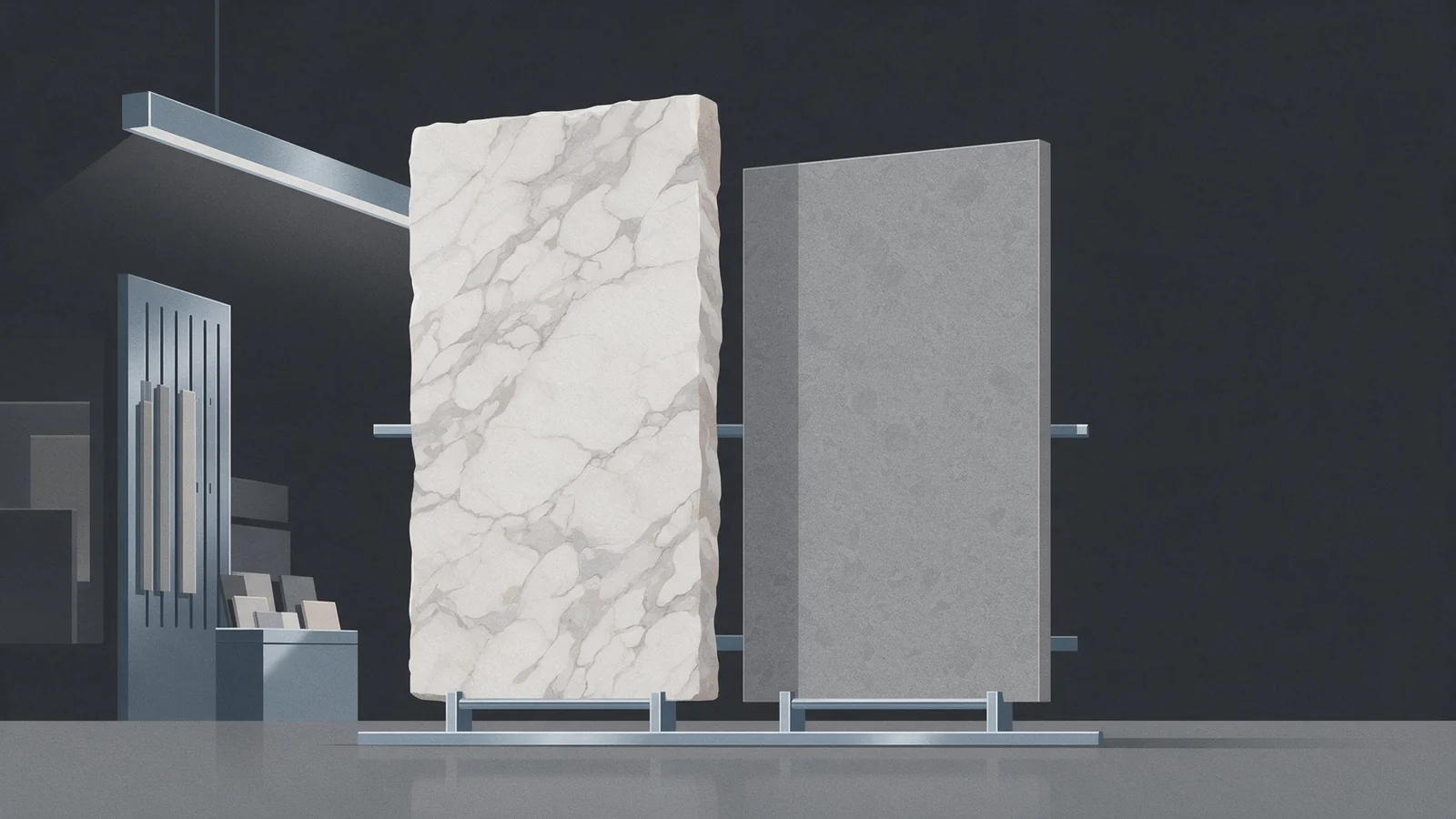
Is Porcelain a Natural Stone?
No. Porcelain is a man-made ceramic. Natural stone is quarried from the earth. Porcelain is manufactured from clay and minerals. People say 'porcelain stone tile' when they mean stone-look porcelain, not actual stone. The composition and production process are entirely different.
That distinction matters for commercial buyers. Natural stone gives you unique geological character, porcelain gives you controlled consistency. Know the difference and you can specify the right material for each part of a project.
Composition and Manufacturing Process
Limestone, marble, slate, granite. Those form over millions of years under geological pressure. Each block has its own veining, color shifts, mineral inclusions. No two slabs look the same.
Porcelain is a different story. It starts with kaolin clay, feldspar, and sand. Mix those, press the body, fire it at high temperatures. Out comes a product made in large batches with uniform color and pattern. Natural stone varies from lot to lot, even within a single slab.
In the North American tile industry, the definition of porcelain tile is water absorption ≤ 0.5%. That number holds no matter what the body is made of. It tells you whether a product sold as porcelain really is porcelain.
Durability and Maintenance
Porcelain is non-porous. It does not stain and never needs sealing. Natural stone is porous and has to be sealed on a regular schedule or stains get in. Scratch and moisture resistance? Porcelain beats most stone there too. But if porcelain gets damaged, you usually replace the whole piece. Natural stone can be refinished.
That means porcelain cuts long-term maintenance in high-traffic commercial spaces. On feature walls or low-traffic areas, the refinishing ability of natural stone extends its service life.
Aesthetics and Design Flexibility
Natural stone gives you patterns and colors you won't see twice. Porcelain is uniform. It can mimic stone, wood, or other materials, but it has pattern repeats. Natural stone does not. Both come in polished, honed, and textured finishes.
Porcelain gives a big area a consistent look without surprises. Natural stone's variation works in boutique projects where each piece is meant to stand out on its own. That is its point.
Cost and Installation Considerations
Porcelain usually costs less than natural stone. Install labor is lower too. On a budget job, porcelain wins on both counts. It cuts uniform and clean, which speeds up installs. Large-format porcelain may need specialized handling. That can add cost. On premium work, though, the unique look of natural stone can be worth the extra money. That is the tradeoff.
Suitability for Different Applications
Porcelain handles high-traffic, wet, and outdoor areas. It's frost-resistant, so it works in freeze-thaw climates. Natural stone can get slippery when wet unless you texture it. Save it for low-traffic spots where looks matter more than wear.
If you're mixing them, put porcelain in corridors and bathrooms. Natural stone belongs in lobbies or on feature walls. That splits performance and aesthetics neatly. Done.
Environmental Impact and Sustainability
Firing porcelain takes a serious amount of energy. Quarrying stone has its own trade-offs. So which one is better? It depends on how long the project lives.
Porcelain can contain recycled material. And because it lasts for decades without needing replacement, that initial energy burn evens out over time. Sourced close to the job site, natural stone skips the long-distance shipping hit. Neither product is clearly greener.
Verifying Quality for Large-Scale Projects
For porcelain, water absorption is the number to watch. Get third party test reports from the supplier. ISO 13006 sorts ceramic tiles by water intake and forming method. But that standard never defines porcelain. So ask for test data from the ISO 10545 series.
Natural stone is different. Every data sheet should list density, absorption, and strength. Pull samples from different lots. You will see the variation yourself. It is real. Winway carries marble, granite, quartz, onyx, slate, sandstone, limestone, basalt, alabaster, travertine and Calacatta marble. We supply stone for villas, hotels, apartments, offices, restaurants, kitchens, bathrooms, walls, floors, rooftops and outdoor projects. Samples are free in every category. You pay the international shipping.
Mixed-Use Projects: Specifying Both Materials
Hotels split spaces this way all the time. Guest baths get porcelain. The lobby gets natural stone. A villa might put porcelain on exterior terraces and marble on interior feature walls. That split is practical, not a compromise.
But thickness and installation methods have to line up. These materials often call for different setting materials and joint widths. Winway's showroom in Foshan is 5,000 m² and shows the full range. You can compare them side by side.
Selecting a Supplier and Evaluating Samples
Pick a supplier who knows your market. Winway has built in Zambia, Tanzania, Uganda, Senegal, the Republic of the Congo, Burkina Faso, Kenya and Ethiopia. Villas, apartments, hotels, a hospital, a spa, a bar.
Get samples first. Check color, texture and finish under different light. Ask about batch consistency. Can they do pre-production samples for custom work? Winway will give you 2-3 design options to approve, free of charge.
Logistics of Shipping Heavy Stone or Porcelain Internationally
Heavy material means real planning. Sea freight takes 15-45 days to the destination port, depending on the route. Air freight gets samples and rush orders there in 5-10 business days.
Winway quotes FOB (Foshan / Guangzhou port), CIF, and EXW. Most international buyers use FOB when they have their own freight forwarder. Pick CIF if you want us to book ocean freight and cargo insurance to the destination port. Door to door is available for some countries.
For large orders, consolidate product categories into one container. Tiles, bathroom fixtures, doors, flooring, kitchen cabinets, and hardware all go into a single FCL shipment from our Foshan warehouse. That saves money and headache.
Customization Options for Large Orders
Porcelain comes in custom sizes, colors, and finishes. Natural stone gets cut to your dimensions and finished to your spec. Both handle big jobs when you need a specific design.
Winway does OEM and ODM across most product lines. Custom orders need a higher MOQ and an approved pre-production sample first. That sample approval step makes sure the final product matches what you signed off on. No surprises later.
Ordering custom porcelain? Ask about the minimum order quantity and lead time right away. For natural stone, confirm the quarry can pull enough material from one block or lot. Otherwise color variation creeps in across your project, and that gets ugly fast.
Need more on importing stone slabs from China? See our article on how to import stone slabs from China. You can also browse our marble and quartz stone collections.